- The Department was established in 2003 with an initial intake of 60 students. The sanctioned intake was subsequently increased to 120 students in 2011 and further enhanced to 180 students in 2019 to accommodate the growing demand for the program.
- The Department offers a Postgraduate programme (M. Tech) in Digital Communication and Networking, providing an opportunity for higher education and specialization in advanced communication technologies among women graduates.
- VTU-recognized ECE Research Centre is established in the department, facilitating faculty members and research scholars to pursue Ph.D. programmes and undertake quality research in cutting-edge domains of Electronics and Communication Engineering.
- Department is accredited by National Board of Accreditation (NBA), New Delhi from 01.07.2017 to 30.06.2020, 01.07.2020 to 30.06.2023 and 01.07.2023 to 30.06.2026
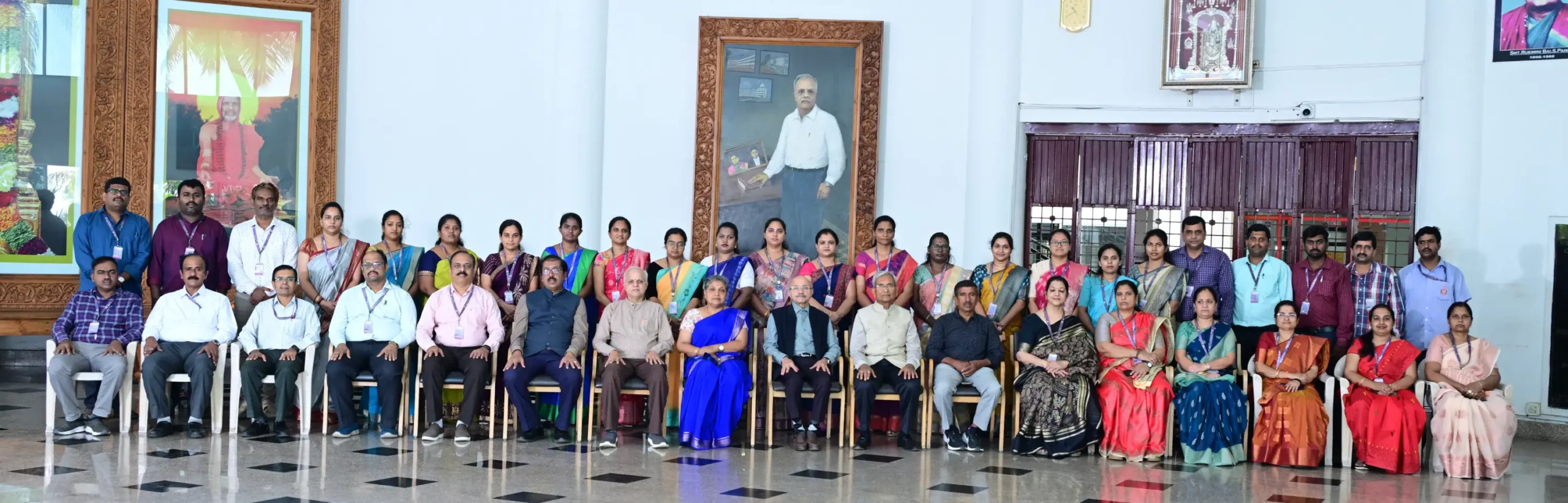
- Department has 29 professionally qualified faculty members with various research specializations.
- The Department has received Nine VTU ranks: 8 in PG and 1 in UG
- The final year students are placed in reputed companies with the highest package of Rs. 31 Lakhs Per Annum.
- ECE Department has established Memoranda of Understanding (MoUs) with leading industries to strengthen industry–academia collaboration, facilitate knowledge exchange, and enhance opportunities for student training, internships, research, and placements.
- The department provides students with diverse platforms to actively engage in professional and technical activities such as technical seminars, elective-based mini projects, industrial visits, workshops, and conferences at intercollegiate levels. These initiatives foster experiential learning, enhance technical competence, and contribute to quality research publications.
- To enhance domain-specific knowledge and practical skills, the department has established four specialized student clubs:
- Signal and Image Processing Club
- Wireless Communication Club
- Embedded Systems and Robotics Club
- VLSI Club
- To bridge the gap between academic learning and industry requirements, the department has also established six dedicated skill laboratories:
- AirLink Lab – Advanced Wireless Communication
- ChipCraft – VLSI Design and Verification
- RoboSys – Embedded Systems & Robotics
- VisionXR – Augmented Reality & Virtual Reality
- SigVision – Signal & Image Processing
- eI-Skill – Electronics Innovation
- The department has established Centre of Excellence for Research in Cyber-Physical Virtual Reality-Based Embodied AI Robotics, fostering advanced research, innovation, and industry-academia collaboration in emerging technologies such as AI, Robotics, Virtual Reality, and Cyber-Physical Systems.
- The department is equipped with modern infrastructure, well-established laboratories, classrooms, computing facilities, and research resources, fully compliant with AICTE and VTU norms.
Vision
To foster professional-level competence in all areas of Electronics and Communication Engineering and to benchmark the Department as a globally recognized centre for nurturing Women Engineers.
Mission
M1: To impart value-based technical education and training while sensitizing students to social, moral, and professional ethics.
M2: To impart theoretical knowledge, practical skills, and entrepreneurship abilities.
M3: To foster a culture of innovation and research for the development of society.
M4: To offer industry-standard certifications that enhance students’ skills and knowledge, thereby preparing them for successful placement.
PEO1: Graduates will excel in their professional career and/or pursue higher education in the field of Electronics and Communication Engineering.
PEO2: Graduates will effectively manage their professional responsibilities by upgrading their skill set to meet the industrial needs.
PEO3: Graduates will demonstrate high regard for human rights & societal needs.
PEO4: Graduates will be able to exhibit ethical values, effective communication skills and teamwork in the workplace.
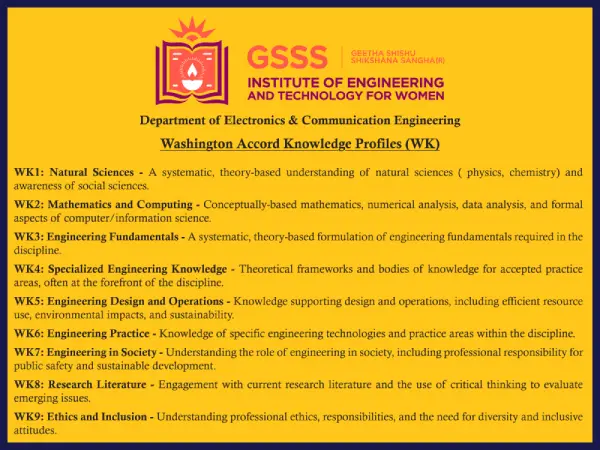
PO1: Engineering Knowledge: Apply knowledge of mathematics, natural science, computing, engineering fundamentals and an engineering specialization as specified in WK1 to WK4 respectively to develop to the solution of complex engineering problems.
PO2: Problem Analysis: Identify, formulate, review research literature and analyze complex engineering problems reaching substantiated conclusions with consideration for sustainable development. (WK1 to WK4)
PO3: Design/Development of Solutions: Design creative solutions for complex engineering problems and design/develop systems/components/processes to meet identified needs with consideration for the public health and safety, whole-life cost, net zero carbon, culture, society and environment as required. (WK5)
PO4: Conduct Investigations of Complex Problems: Conduct investigations of complex engineering problems using research-based knowledge including design of experiments, modelling, analysis & interpretation of data to provide valid conclusions. (WK8).
PO5: Engineering Tool Usage: Create, select and apply appropriate techniques, resources and modern engineering & IT tools, including prediction and modelling recognizing their limitations to solve complex engineering problems. (WK2 and WK6)
PO6: The Engineer and The World: Analyze and evaluate societal and environmental aspects while solving complex engineering problems for its impact on sustainability with reference to economy, health, safety, legal framework, culture and environment. (WK1, WK5, and WK7).
PO7: Ethics: Apply ethical principles and commit to professional ethics, human values, diversity and inclusion; adhere to national & international laws. (WK9)
PO8: Individual and Collaborative Team work: Function effectively as an individual, and as a member or leader in diverse/multi-disciplinary teams.
PO9: Communication: Communicate effectively and inclusively within the engineering community and society at large, such as being able to comprehend and write effective reports and design documentation, make effective presentations considering cultural, language, and learning differences
PO10: Project Management and Finance: Apply knowledge and understanding of engineering management principles and economic decision-making and apply these to one’s own work, as a member and leader in a team, and to manage projects and in multidisciplinary environments.
PO11: Life-Long Learning: Recognize the need for, and have the preparation and ability for i) independent and life-long learning ii) adaptability to new and emerging technologies and iii) critical thinking in the broadest context of technological change. (WK8)
PSO1 – Construct and/or Simulate Electronics- Ability to formulate, design, develop, implement, and demonstrate effective solutions to electronics-related problems using appropriate hardware, software, and simulation tools.
PSO2 – Construct and/or Simulate Communication Systems-Ability to identify, analyze, design, and implement solutions for communication system problems using communication concepts, simulation tools, and hardware for signal transmission and reception.
PSO3 – Human Values and Holistic Development- Ability to exhibit research, entrepreneurship and professional skills supporting holistic personal development alongside technical competence.
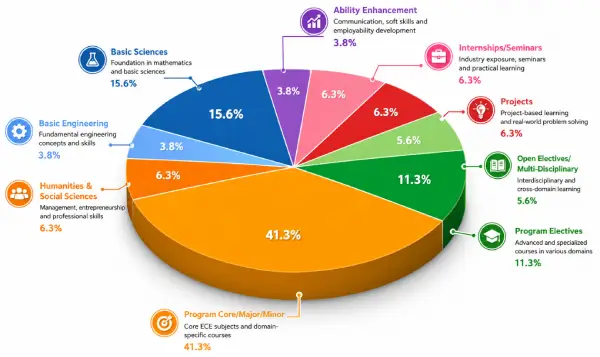
The programme consists of the following categories of courses:
- Basic Sciences: Mathematics and other foundational science courses that provide the mathematical and scientific foundation required for engineering studies.
- Basic Engineering: Foundational engineering courses covering fundamental concepts of programming, engineering fundamentals, electrical/electronic systems and other introductory engineering subjects.
- Humanities and Social Sciences: Courses such as Management and Entrepreneurship, which develop managerial, entrepreneurial, communication and professional skills.
- Program Core/Major/Minor: Core Electronics and Communication Engineering courses including Network Analysis, Field Theory, Analog Electronic Circuits, Fundamentals of CMOS VLSI Design, Fundamentals of HDL Programming, Signals and Systems, Digital Signal Processing, Analog Communication, Digital Communication, Speech Processing, Image Processing, and other domain-specific courses.
- Program Electives: Advanced and specialized courses offered in areas such as VLSI, Signal Processing, Communication Systems, Embedded Systems, Wireless Communication, Image/Speech Processing, and related emerging technologies.
- Open Electives/Multi-Disciplinary: Courses that enable students to acquire knowledge from other engineering disciplines and interdisciplinary areas, including Computer Science, Artificial Intelligence, Data Science and other emerging technology domains.
- Project(s): Project-based courses that provide students with opportunities to apply engineering knowledge to solve real-world problems through individual and/or team-based projects.
- Internships/Seminars: Internships, seminars, project presentations and industry-oriented learning activities that provide practical exposure and enhance professional competencies.
- Any Other:
- Ability Enhancement: Courses/activities aimed at improving communication, professional and employability skills.
- Skill Enhancement: Hands-on training, laboratory work, programming, simulation, hardware implementation and other practical skill-development activities.
- Value Addition: Courses and activities related to professional ethics, environmental awareness, entrepreneurship, innovation, sustainability and societal responsibility.
- Other: MOOCs, certification courses, value-added courses and co-curricular/extracurricular activities that support the overall professional development of students.
Program Curriculum grouping based on curriculum components (2022 VTU scheme)
| Curriculum Component | Curriculum Content (% of total number of credits of the program) | Total number of contact hours | Total number of credits |
| Basic Sciences | 15.62 | 750 | 25 |
| Basic Engineering | 3.75 | 180 | 06 |
| Humanities and Social Sciences | 6.25 | 310 | 10 |
| Program Core/Major/Minor | 41.25 | 1980 | 66 |
| Program Electives | 11.25 | 540 | 18 |
| Open Electives/Multi-Disciplinary | 5.62 | 270 | 09 |
| Project(s) | 6.25 | 300 | 10 |
| Internships/Seminars | 6.25 | 300 | 10 |
| Any other (Please specify)- A. Ability enhancement B. Skill Enhancement C. Value add process D. etc. | 3.75 | 180 | 06 |
| Total number of credits: | 160 | ||