The CSE (AI & ML) program is designed to equip students with cutting-edge technical skills tailored for the 21st century, aligning with the growing global AI market. As per the Precedence Research Report 2023, the U.S. artificial intelligence (AI) market size accounted for USD 103.7 billion in 2022 and is estimated to reach around USD 594 billion by 2032, growing at a CAGR of 19.1% from 2023 to 2032.
- Established in 2021 with an intake of 60 students.
- The department has 6 faculty members with 2 Ph.D.’s. and 1 is pursuing Ph.D. in various disciplines.
- In 2026 69% of the final year students are placed in reputed companies with the highest package of Rs. 22 Lakhs Per Annum.
- In 2025 60% of the final year students are placed in reputed companies with the highest package of Rs. 31 Lakhs Per Annum.
- The department has bagged 3 VTU Ranks from the 2025 Graduating Batch
- Department has Samsung Innovation Campus established in 2025 with investment of ₹. 1 Cr+ from Samsung R&D Institute India, Bengaluru.
- The department encourages has many initiatives for Students Skill development.
- Department has initiated Developer Cell to give live project to Students and 20+ Application has been Designed and developed by Students and Staff of Department and 10 Applications has been Copyrighted.
- Department has required infrastructure as per AICTE and VTU norms. Major Facilities available- 03 GPU Workstations, 100+ Desktops with 16GB RAM, IOT Kits and Wi-Fi Internet Facilities.
Vision
Provide quality education and training to equip students with the skills and knowledge required to excel in Computer Science, AI and ML related careers
Mission
M1: To Encourage faculty and students to engage in continuous learning to keep pace with the rapidly evolving landscape of Computer Science, AI and ML.
M2: To Promote the development and use of Computer Science, AI and ML technologies that adhere to ethical principles, ensuring fairness, transparency, accountability, and privacy in AI systems.
M3: To Develop Computer Science, AI and ML technologies and tools that can be applied to solve real-world problems in various domains, including healthcare, finance, and transportation.
M4: To sensitize the Students regarding Social, Moral and Professional ethics.
M5: To foster collaboration across various disciplines, breaking down silos to create a holistic approach to solving complex problems with Computer Science, AI and ML.
- PEO1: To have successful careers in Computer Science, AI and ML-related fields by becoming an expert in the various domain
- PEO2:To exhibit a deep understanding of ethical considerations in Computer Science, AI and ML, ensuring that they develop and apply these technologies in a responsible and socially conscious manner.
- PEO3: To engage in lifelong learning and professional development, staying up-to-date with the latest advancements in Computer Science, AI and ML and continuously enhancing their skills.
- PEO4: To actively contribute to society by leveraging Computer Science, AI and ML for the benefit of humanity, whether through improving healthcare outcomes, addressing environmental challenges, or enhancing accessibility.
Engineering Graduates will be able to:
PO1: Engineering Knowledge: Apply knowledge of mathematics, natural science, computing, engineering fundamentals and an engineering specialization as specified in WK1 to WK4 respectively to develop to the solution of complex engineering problems.
PO2: Problem Analysis: Identify, formulate, review research literature and analyze complex engineering problems reaching substantiated conclusions with consideration for sustainable development. (WK1 to WK4)
PO3: Design/Development of Solutions: Design creative solutions for complex engineering problems and design/develop systems/components/processes to meet identified needs with consideration for the public health and safety, whole-life cost, net zero carbon, culture, society and environment as required. (WK5)
PO4: Conduct Investigations of Complex Problems: Conduct investigations of complex engineering problems using research-based knowledge including design of experiments, modelling, analysis & interpretation of data to provide valid conclusions. (WK8).
PO5: Engineering Tool Usage: Create, select and apply appropriate techniques, resources and modern engineering & IT tools, including prediction and modelling recognizing their limitations to solve complex engineering problems. (WK2 and WK6)
PO6: The Engineer and The World: Analyse and evaluate societal and environmental aspects while solving complex engineering problems for its impact on sustainability with reference to economy, health, safety, legal framework, culture and environment. (WK1, WK5, and WK7).
PO7: Ethics: Apply ethical principles and commit to professional ethics, human values, diversity and inclusion; adhere to national & international laws. (WK9)
PO8: Individual and Collaborative Team work: Function effectively as an individual, and as a member or leader in diverse/multi-disciplinary teams.
PO9: Communication: Communicate effectively and inclusively within the engineering community and society at large, such as being able to comprehend and write effective reports and design documentation, make effective presentations considering cultural, language, and learning differences
PO10: Project Management and Finance: Apply knowledge and understanding of engineering management principles and economic decision-making and apply these to one’s own work, as a member and leader in a team, and to manage projects and in multidisciplinary environments.
PO11: Life-Long Learning: Recognize the need for, and have the preparation and ability for i) independent and life-long learning ii) adaptability to new and emerging technologies and iii) critical thinking in the broadest context of technological change. (WK8)
PSO1:
Apply Artificial Intelligence and Machine Learning techniques to design and implement intelligent solutions for domain-specific real-world applications.
PSO2:
Develop and deploy ethical, data-driven AI and ML models using modern tools and platforms to address practical and industry-relevant problems.
The course consists of:
The chart below gives the distribution of course contents representing blending of subjects of different skill areas of the UG Course.
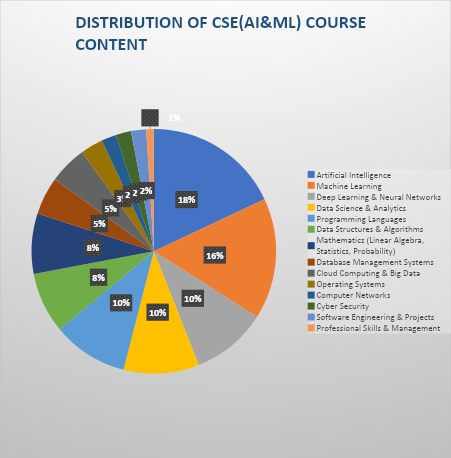
Apart from the course – Students will undergo Internship and Projects. And the department had many initiatives to make the learning better with – Project Based Learning, Mini Projects, Experienced based Learning Assignments.
Students also carry out AICTE Activity Point as prescribed by VTU & AICTE a non-credit course to ensure them to build non-technical skill as well contribution towards society