- Established in 2003 with an intake of 60 students and later increased to 120 in take
in 2012. - Accredited by National Board of Accreditation (NBA), New Delhi from 01.07.2017 to
30.06.2020, 01.07.2020 to 30.06.2023 and 01.07.2023 to 30.06.2026 - The department has 21 faculty members with 7 Ph.D’s. and 6 are pursuing Ph.D in
various disciplines. - 75% of the final year students are placed in reputed companies with the highest
package of Rs. 30.20 Lakhs Per Annum. - The department has bagged 4 VTU Ranks: 3 in UG and 1 in UG.
- VTU recognized Research Centre is established which facilitates faculty members to
pursue their PhD. - The department has acquired Rs 30 Lakhs funds from Vision Group on Science and
Technology (VGST), Government of Karnataka for establishment of “Innovative
Smart Systems and IoT Laboratory” during the period 2016-2019. - Received Best Accredited Student Branch Award from CSI for 3 consecutive years.
- Memorandum of Understanding (MoUs) has been formally signed between
GSSSIETW, Mysuru with leading industries. - The department encourages the students to participate in International/National
Conferences/workshops, to showcase the knowledge or to imbibe valuable
professional development opportunities. - Department has required infrastructure as per AICTE and VTU norms.
Vision
Knowledge dissemination with development of future leaders in Information Technology having a research blend
Mission
M1: To equip students with continuous learning process to acquire Hardware, Software and Computing knowledge to face new challenges.
M2: To inculcate the core Computer Science and Engineering components with discipline among the students by providing the state-of-the-art learner centric environment.
M3: To impart essential knowledge through quality and value based education to mould them as a complete Computer Science Engineer with ethical values, leadership roles by possessing good communication skills and ability to work effectively as a team member.
M4: To provide a platform to collaborate with successful people from entrepreneurial and research domains to learn and accomplish.
- PEO1: To produce graduates satisfying Computer Science Engineering challenges.
- PEO2: To meet dynamic requirements of IT industries professionally and ethically along with social responsibilities.
- PEO3: To provide Computer Science and Engineering graduates to support nation’s self employment growth with women entrepreneurial skills.
- PEO4: To equip Graduates with minimum research blend for further career challenges internationally.
PO1: Engineering Knowledge: Apply knowledge of mathematics, natural science, computing, engineering fundamentals and an engineering specialization as specified in WK1 to WK4 respectively to develop to the solution of complex engineering problems.
PO2: Problem Analysis: Identify, formulate, review research literature and analyze complex engineering problems reaching substantiated conclusions with consideration for sustainable development. (WK1 to WK4)
PO3: Design/Development of Solutions: Design creative solutions for complex engineering problems and design/develop systems/components/processes to meet identified needs with consideration for the public health and safety, whole-life cost, net zero carbon, culture, society and environment as required. (WK5)
PO4: Conduct Investigations of Complex Problems: Conduct investigations of complex engineering problems using research-based knowledge including design of experiments, modelling, analysis & interpretation of data to provide valid conclusions. (WK8).
PO5: Engineering Tool Usage: Create, select and apply appropriate techniques, resources and modern engineering & IT tools, including prediction and modelling recognizing their limitations to solve complex engineering problems. (WK2 and WK6)
PO6: The Engineer and The World: Analyze and evaluate societal and environmental aspects while solving complex engineering problems for its impact on sustainability with reference to economy, health, safety, legal framework, culture and environment. (WK1, WK5, and WK7).
PO7: Ethics: Apply ethical principles and commit to professional ethics, human values, diversity and inclusion; adhere to national & international laws. (WK9)
PO8: Individual and Collaborative Team work: Function effectively as an individual, and as a member or leader in diverse/multi-disciplinary teams.
PO9: Communication: Communicate effectively and inclusively within the engineering community and society at large, such as being able to comprehend and write effective reports and design documentation, make effective presentations considering cultural, language, and learning differences
PO10: Project Management and Finance: Apply knowledge and understanding of engineering management principles and economic decision-making and apply these to one’s own work, as a member and leader in a team, and to manage projects and in multidisciplinary environments.
PO11: Life-Long Learning: Recognize the need for, and have the preparation and ability for i) independent and life-long learning ii) adaptability to new and emerging technologies and iii) critical thinking in the broadest context of technological change. (WK8)
- PSO1: Enable students to design system and system architecture, inculcating software, computing and analytical ability.
- PSO2: Enhance skills to be successful in National, International level competition like GATE, GRE, GMAT.
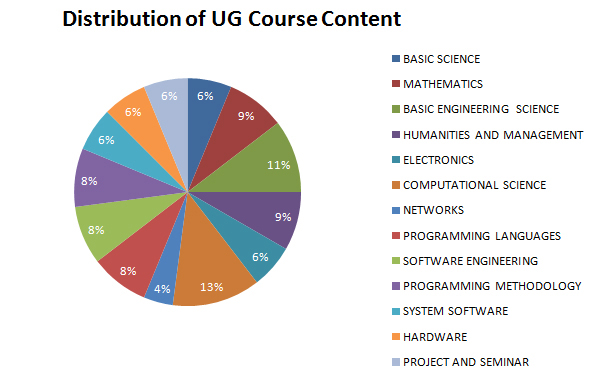
The course consists of:
The chart below gives the distribution of course contents representing blending of subjects of different skill areas of the UG Course.