Vision
To foster professional-level competence in all areas of Electronics and Communication Engineering and to benchmark the Department as a globally recognized centre for nurturing Women Engineers.
Mission
M1: To impart value-based technical education and training while sensitizing students to social, moral, and professional ethics.
M2: To impart theoretical knowledge, practical skills, and entrepreneurship abilities.
M3: To foster a culture of innovation and research for the development of society.
M4: To offer industry-standard certifications that enhance students’ skills and knowledge, thereby preparing them for successful placement.
PEO1: To inculcate students to excel in professional career and/or higher education by acquiring knowledge in the field of Electronics and Communication.
PEO2: To make the students capable of managing their profession based on existing as well as new emerging technologies in the area of Electronics and Communication Engineering.
PEO3: To Produce Technically competent graduates with ability to analyze, design, develop, optimize and implement Electronics and Communication systems.
PEO4: To prepare the students to be able to exhibit professionalism, ethical attitude, communication skills, team work in their profession and to adapt to current trends by engaging in life-long learning.
Engineering Graduates will be able to:
- Engineering knowledge: Apply the knowledge of mathematics, science, engineering fundamentals, and an engineering specialization to the solution of complex engineering problems.
- Problem analysis: Identify, formulate, review research literature, and analyze complex engineering problems reaching substantiated conclusions using first principles of mathematics, natural sciences, and engineering sciences.
- Design/development of solutions: Design solutions for complex engineering problems and design system components or processes that meet the specified needs with appropriate consideration for the public health and safety, and the cultural, societal, and environmental considerations.
- Conduct investigations of complex problems: Use research-based knowledge and research methods including design of experiments, analysis and interpretation of data, and synthesis of the information to provide valid conclusions.
- Modern tool usage: Create, select, and apply appropriate techniques, resources, and modern engineering and IT tools including prediction and modeling to complex engineering activities with an understanding of the limitations.
- The engineer and society: Apply reasoning informed by the contextual knowledge to assess societal, health, safety, legal and cultural issues and the consequent responsibilities relevant to the professional engineering practice.
- Environment and sustainability: Understand the impact of the professional engineering solutions in societal and environmental contexts, and demonstrate the knowledge of, and need for sustainable development.
Ethics: Apply ethical principles and commit to professional ethics and responsibilities and norms of the engineering practice. - Individual and team work: Function effectively as an individual, and as a member or leader in diverse teams, and in multidisciplinary settings.
- Communication: Communicate effectively on complex engineering activities with the engineering community and with society at large, such as, being able to comprehend and write effective reports and design documentation, make effective presentations, and give and receive clear instructions.
- Project management and finance: Demonstrate knowledge and understanding of the engineering and management principles and apply these to one’s own work, as a member and leader in a team, to manage projects and in multidisciplinary environments.
- Life-long learning: Recognize the need for, and have the preparation and ability to engage in independent and life-long learning in the broadest context of technological change.
PSO1: Apply concepts of electronics, signal processing, and embedded systems to design, analyze, and implement real-time solutions for communication and automation systems.
PSO2: Demonstrate the ability to develop and integrate hardware-software co-design solutions using modern tools in VLSI, IoT, and wireless technologies, aligned with industry needs and societal applications.
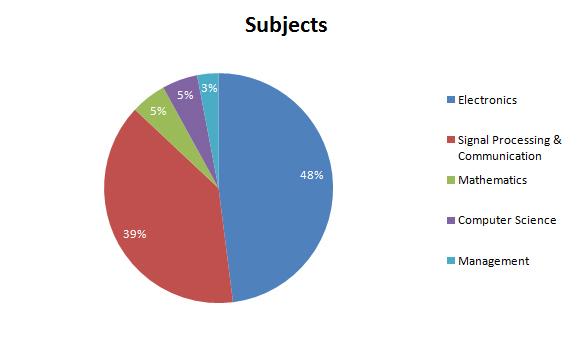
The course consists of:
Electronics subjects like Fundamentals of CMOS VLSI Design, Fundamentals of HDL programming, Network Analysis, Field Theory, Analog Electronics circuits and etc. Signal Processing & Communication subjects like Signals and Systems, Digital Signal Processing, Speech Processing, Image Processing, Analog Communication, Digital communication and etc. Computer science subjects like operating systems, Programming in C++ and etc. Management subjects like Management and entrepreneurship and etc. Mathematics subjects like Mathematics III, Mathematics IV and etc.