Department
Home » Information Science & Engineering
INFORMATION SCIENCE & ENGINEERING -Accredited by NBA, New Delhi
(Validity: 01.07.2017 - 30.06.2020, 01.07.2020 - 30.06.2023 & 01.07.2023 - 30.06.2026)
About the Department : Intake of the Department = 60
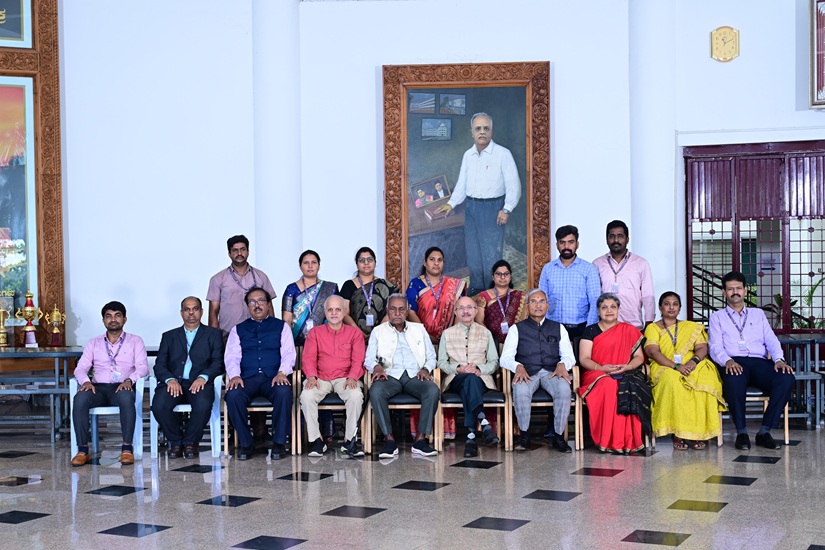
- Established in 2003 with an intake of 60 students.
- 90% of the final year students are placed in reputed companies with highest package of Rs. 32.7 Lakhs per annum.
- Accredited by National Board of Accreditation (NBA), New Delhi from 01.07.2017 to 30.06.2020, 01.07.2020 to 30.06.2023 and 01.07.2023 to 30.06.2026
- Update with: The departement has 08 faculty members with 04 Ph.D. and 01 pursuing Ph.D.
- Department has been sanctioned with a grant of Rs 14,60,700/- from various Government and Funding agencies.
- Successfully organized “3rd International Conference on Adaptive Computational Intelligence” (ICACI 2022) in Technical Collaboration with Springer, during the year 2022.
- Successfully organized “International Conference Electrical, Electronics, Communication, Computer Technologies and Optimization Techniques (ICEECCOT)” in Association with IEEE Bangalore Section from 2016, 2017, 2018, 2019 & 2021. This event was organized in association with AICTE had sanctioned Rs,3,83,700/- as Financial Assistance for conducting ICEECCOT-2021 conference under AICTE – GOC (Grant for Organizing Conference) scheme.
- Students are encouraged to participate in various Inter/Intra College techno-cultural competitions. Students of ISE department have brought laurels to the department and the institute by wining prizes at different events that they have participated.
- The faculties of the department have published patents, book chapters and papers in various research domains as well as delivered technical sessions as a Resource Person.
- Department has required infrastructure as per AICTE and VTU norms.
Vision
To be recognized nationally as an accomplished department producing global leaders and researchers as committed, enthusiastic and excellent ethical women technical graduate for the better tomorrow.
Mission
M1: To provide Students with Innovative and research skills, which is need of the hour for technical students.
M2: To impart knowledge to the students of Information Science and Engineering with relevant core and practical knowledge inculcating real time experience in the promising field of computing.
M3: To prepare the graduates to meet information technology challenges with a blend of social, human, ethical and value based education.
- PEO1: To produce graduates who have the ability to demonstrate technical competence in the fields of information Technology and develop solutions to the problems.
PEO2: Gain the ability to analyze and solve Information science and engineering problems through application of fundamental knowledge of maths, science, and engineering.
PEO3: To endeavor innovations with a substantial fundamental technical skills aiming the career in research and development.
PEO4: Understand and deal with ethical, societal and global issues associated with the computing profession.
PEO5: Exhibit professionalism, leadership roles, team work in meeting the growing demands of IT industry.
- PO1: Engineering knowledge: Apply the knowledge of mathematics, science, engineering fundamentals, and an engineering specialization to the solution of complex engineering problems.
- PO2: Problem analysis: Identify, formulate, review research literature, and analyze complex engineering problems reaching substantiated conclusions using first principles of mathematics, natural sciences, and engineering sciences.
- PO3: Design/development of solutions: Design solutions for complex engineering problems and design system components or processes that meet the specified needs with appropriate consideration for the public health and safety, and the cultural, societal, and environmental considerations.
- PO4:Conduct investigations of complex problems: Use research-based knowledge and research methods including design of experiments, analysis and interpretation of data, and synthesis of the information to provide valid conclusions.
- PO5:Modern tool usage: Create, select, and apply appropriate techniques, resources, and modern engineering and IT tools including prediction and modeling to complex engineering activities with an understanding of the limitations.
- PO6: The engineer and society: Apply reasoning informed by the contextual knowledge to assess societal, health, safety, legal and cultural issues and the consequent responsibilities relevant to the professional engineering practice.
- PO7: Environment and sustainability: Understand theimpact of the professional engineering solutions in societal and environmental contexts, and demonstrate the knowledge of, and need for sustainable development.
- PO8: Ethics: Apply ethical principles and commit to professional ethics and responsibilities and norms of the engineering practice.
- PO9: Individual and team work: Function effectively as an individual, and as a member or leader in diverse teams, and in multidisciplinary settings.
- PO10: Communication: Communicate effectively on complex engineering activities with the engineering community and with society at large, such as, being able to comprehend and write effective reports and design documentation, make effective presentations, and give and receive clear instructions.
- PO11: Project management and finance: Demonstrate knowledge and understanding of the engineering and management principles and apply these to one’s own work, as a member and leader in a team, to manage projects and in multidisciplinary environments.
- PO12: Life-long learning: Recognize the need for, and have the preparation and ability to engage in independent and life-long learning in the broadest context of technological change.
PSO1 :Participate in planning, implementing, evaluating reliable and secure IT Solutions to specific business problems.
PSO2 : Enabling the students with Project Management Skill through Software Development life Cycle.
Our Academic Partners