Vision
To achieve excellence in technical education and research to serve as a valuable resource center for industry and society through innovation and team work leading to global competence.
Mission
M1:To provide students with technical knowledge, practical and managerial skills t
hat will enable the graduating engineers to serve the society better with ethical values.
M2: To undertake synergetic projects which offers opportunities for long term interaction with academic and industry.
M3: To prepare the students to visualize beyond the stochastic thinking and belong to a new era of acquisition and application of instrumentation technology to meet the requisition of the changing world.
- PEO1:To provide a strong foundation in the field of Instrumentation Technology to analyze and solve the engineering problems.
- PEO2: Pursue their higher studies at the reputed institutes in India and abroad and work in educational institutions, research organizations and engineering consultancy companies or to become entrepreneur.
- PEO3: Communicate and work effectively as individuals or in professional teams.
- PEO4: Exhibit professionalism, ethical attitude and adapt for current trends and upgrading technology by fascinating in lifelong learning.
- PEO5: Motivate graduates to become good human beings and responsible citizens for the overall welfare of the society.
PO2: Ability to identify and analyze a problem and formulate appropriate solutions in the field of Instrumentation Technology.
PO3: Ability to apply current knowledge and adapt to upgrading Technology for quality, timeliness, continuous improvement and specific needs for the industries.
PO4: Ability to have competency to develop necessary model, simulate and implement solutions relating to instrumentation engineering.
PO5: An ability to use the techniques, skills, and wide range of modern software tools related to instrumentation engineering for design, development, simulation, implementation, verification and certification.
PO6: An ability to understand professional, social responsibilities and social issues associated with different courses of action. PO7: Impact of the professional engineering solutions in societal and environmental contexts and demonstrate the knowledge and need for sustainable development.
PO8: Apply ethical principles and commit to professional ethics and responsibilities and norms of the engineering practice.
PO9: Function effectively as an individual, and as a member or leader in diverse teams and in multidisciplinary settings. PO10: Ability to communicate effectively through a written documents/ oral presentations and to develop, prepare, interpret effective visual and graphical information in global scenario.
PO11: Ability to lead project team by incorporating appropriate engineering and management principles for successful completion of project in multidisciplinary environment.
PO12: Self improvement through the continuous professional development and ability to engage in independent and lifelong learning.
PSO1: Students will have the ability to explore the concepts of measurement and sensor selection to
Identify, and troubleshoot various process instruments commonly used in automation industry
PSO2: Enables the Students to design the elements of a control system from a practical, working
perspective, and comprehend how these elements affect overall system operation and tuning in
measurement and instrumentation.
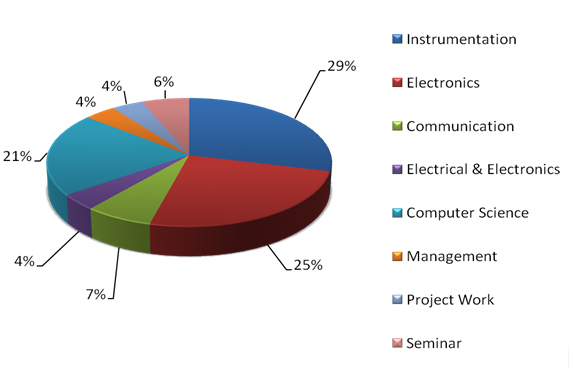 Distribution of Course Content